


Your jeans fit at 8am. By 4pm the waistband is digging in, and by the evening you look a few months pregnant. Tomorrow morning your stomach is flat again, and the whole cycle starts over.
The short version
- Nearly 1 in 5 adults feel bloated at least once a week, and women report it about twice as often as men.
- Feeling bloated and looking swollen are related, but they’re not the same.
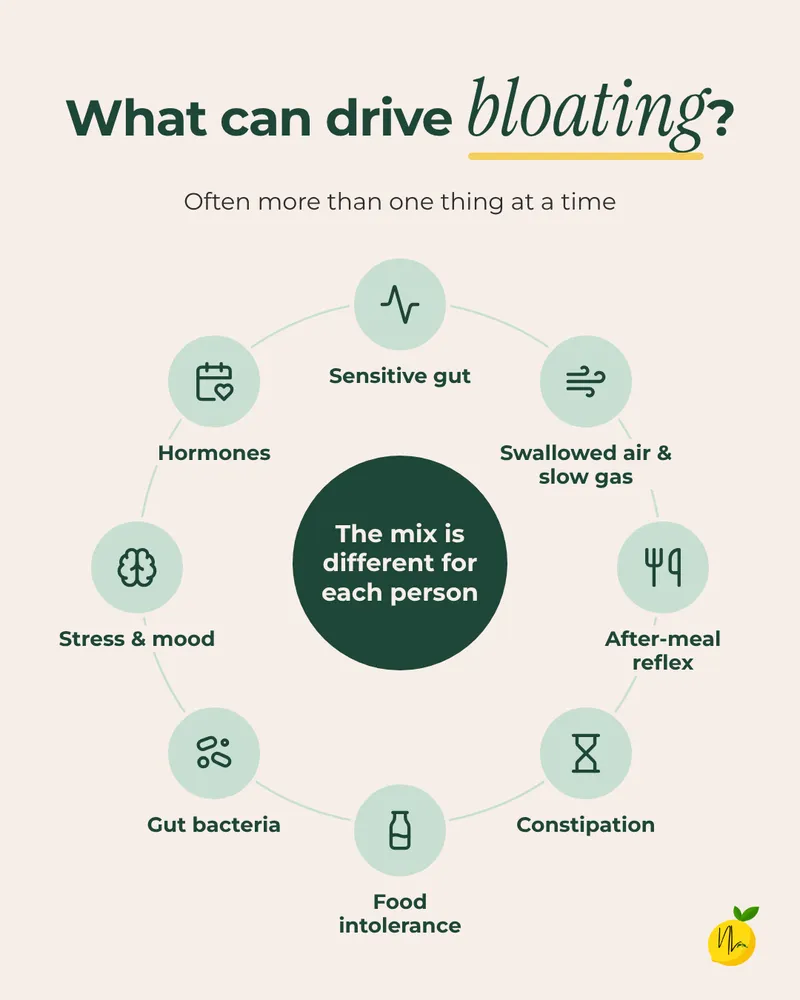
- Several things can drive it: a sensitive gut, gas that doesn’t move well, an after-meal muscle reflex, constipation, food intolerance, gut bacteria, stress and hormones. The mix is different for each person.
- Bloating that is new, won’t go away or comes with other symptoms needs a GP check first, especially for women over 50.
- Cutting out food after food rarely settles it on its own. A personalised plan works on your own drivers.
This article is for general information. It isn’t medical advice and doesn’t replace advice from your GP. If you have new, persistent or worsening symptoms, please speak to your GP.
What’s the difference between feeling bloated and looking bloated?
Feeling bloated is the sense of fullness, pressure or tightness in your tummy. Looking bloated, which doctors call distension, is your waist actually getting bigger. You can have one without the other [1].
The difference matters because they tend to have different triggers. The feeling is closely linked to how sensitive your gut is. The visible swelling is more often linked to how your tummy muscles and diaphragm (the large breathing muscle under your ribs) respond after a meal [1].
How common is daily bloating?
Very common. Nearly 1 in 5 adults worldwide feel bloated at least once a week, and women are about twice as likely as men to report it [2]. It often comes alongside other gut symptoms, such as tummy pain or constipation.
Why am I always bloated?
Bloating usually has more than one driver, and the mix is different for each person [1]. For one person the main driver is constipation; for another it’s hormones, or a stressful few months. These are the main ones.
A sensitive gut
For some people, the gut and brain register normal amounts of gas and stretch as uncomfortable. This is called a sensitive gut (visceral hypersensitivity) [1].
Swallowed air and gas that doesn’t move well
Some air goes down every time you eat or drink, and some people swallow more without noticing. When gas moves slowly or gets held up, it builds up and you feel it [1].
An after-meal muscle reflex
The visible “food baby” is often a muscle reflex: after a meal, the diaphragm pushes down while the tummy wall relaxes, so the belly is pushed outwards [1]. It’s one reason swelling builds through the day and settles overnight.
Constipation
More than 9 in 10 people with ongoing constipation feel bloated [1]. Going every day isn’t always the same as emptying fully.
Food intolerance
Some carbohydrates, such as lactose (the natural sugar in milk) and other FODMAPs, aren’t fully absorbed by everyone, so gut bacteria break them down and make gas [1].
Gut bacteria
People with bloating often have less variety in their gut bacteria, which may affect how the gut moves and how sensitive it is, although most studies were in people with IBS [4]. For some, bloating starts after a tummy bug that upset the balance of gut bacteria [5].
Stress and the gut–brain link
Your gut and brain are in constant contact, so stress, anxiety and low mood can make the gut more sensitive and change how it moves and how you breathe [1]. This side of bloating is often overlooked [6].
Hormones
Changing oestrogen and progesterone levels affect how the gut moves and how sensitive it is, which is why bloating often follows the menstrual cycle and can change in perimenopause [1]. A regular monthly pattern of worsening pain and bloating is worth raising with your GP, as it can be a sign of endometriosis [1].
Could it be IBS or something else?
Bloating is common in IBS (irritable bowel syndrome), a pattern of repeated tummy pain linked to changes in bowel habit, but many people have bloating without IBS [1]. Sometimes bloating is linked to another condition, such as coeliac disease, inflammatory bowel disease, the pancreas not making enough digestive enzymes, an underactive thyroid or diabetes [1]. That’s why it’s important for your GP to rule these out first, usually with simple tests.
When should I see a GP about bloating?
See your GP if bloating keeps coming back, or comes with weight loss you can’t explain or blood in your poo. Ask for an urgent appointment or call 111 if it comes with [7]:
- vomiting, diarrhoea or constipation
- a stomach ache
- a fever, or feeling hot, cold or shivery
- a swelling or lump in your tummy
- being unable to pee, poo or pass wind
For women, especially over 50: new bloating that doesn’t go away is a reason to see your GP before anything else. NICE advises GPs to check for ovarian cancer if a woman, especially one aged 50 or over, often has bloating, feels full quickly or loses her appetite, has tummy or pelvic pain, or needs to pee more urgently or often, particularly more than 12 times a month [8].
What does the research support for bloating?
Research points to several approaches that may help with bloating, depending on what’s driving it [1]:
- regular movement, such as walking or other aerobic exercise
- a structured, short-term diet approach such as low FODMAP, with foods added back step by step
- retraining the after-meal reflex with guided breathing techniques [3]
- gut-focused talking therapies, such as CBT or gut-directed hypnotherapy [6]
- research on probiotics is mixed, and results from one product can’t be applied to another [4]
What helps one person may do little for another, which is why the starting point is your own drivers.
How can nutritional therapy support you?
Because the drivers are different for everyone, the support is too. Our role is to work with you on the everyday food, nutrition and lifestyle choices that are within your reach, built around what’s driving your bloating.
Getting the full picture
We start with a detailed look at your health history and your symptom pattern through the day and the month. We also take a detailed food history: not just what you eat, but when, how fast and how much. Your bowel rhythm, stress, sleep and daily routine are part of the picture too.
Testing, not guessing
Where it’s clinically appropriate, functional testing may be recommended to assess nutritional imbalances and inform personalised diet and lifestyle recommendations to support wellbeing. Testing isn’t used to diagnose. It helps us base your plan on your own results rather than guesswork. If anything points to a medical cause, we’ll refer you back to your GP.
A plan built around your drivers
We then draw on three areas, matched to what’s driving your bloating:
Nutrition & Supplementation: how your meals are put together, support for a regular bowel rhythm, nutritional support for digestion and the gut lining, support for a varied gut microbiome, and targeted supplements where appropriate.
Lifestyle & Environment: meal size, pace and timing; the nervous system, which is often a large part of the work; movement, sleep and daily rhythm; your hormonal stage of life; and the everyday load your body is carrying.
Mindset & Coaching: changing habits is hard when you’re busy and fed up with your stomach. Coaching helps you turn the plan into habits that fit your real life, and adjust them when you need to.
Why cutting out more foods isn’t usually the answer
In clinic, we often meet people who have already cut out gluten, dairy, onions and half their diet, and are still bloated. Cutting out a food can be a useful short-term tool, but on its own it rarely changes the everyday patterns that shape how your gut feels, and cutting out too much for too long can narrow the variety your gut bacteria need. Any change to food has a clear purpose and an end point.
A personalised plan, not a diet sheet
Two people with the same bloating can need very different plans. For one, constipation is the main thread. For another, it’s a stressed nervous system and a diaphragm that tightens after every meal. For a third, it follows her cycle. So there’s no generic protocol. Your plan is built in stages and adjusted as your body responds. The aim is a gut that feels stable and predictable again, so you can stop planning your day around your waistband.
Quick answers
Why do I look pregnant when I’m bloated?
Often it’s a muscle reflex after meals, not lots of gas. The diaphragm pushes down and the tummy wall relaxes, so the belly is pushed outwards. This reflex can be retrained.
Is it normal to be bloated every day?
It’s common, but you don’t have to just live with it. If it’s daily or getting worse, see your GP first to rule out other causes. Then we can work with you on what’s driving it, with a plan built around you.
Should I cut out gluten or dairy?
Not without a reason. If coeliac disease is a possibility, get tested first and keep eating gluten until then, because cutting it out early can affect the result. Looking at the wider picture, such as how and when you eat, sleep and stress, usually tells you more.
Will probiotics help my bloating?
The research is mixed, and each product is different. It’s best decided as part of a personalised plan.
Can bloating be hormonal?
Yes. It often changes across the menstrual cycle and can shift in perimenopause. A regular monthly pattern of pain and bloating is worth raising with your GP.
When is bloating serious?
See your GP if bloating won’t go away, is new after 50, or comes with weight loss, blood in your poo, a lump, vomiting, fever or changes in your bowel habit.
The bottom line
Daily bloating is common, and the mix of drivers is different for each person. Once your GP has ruled out other causes, working on your own drivers gives you a clearer way forward than cutting out one food after another.
If you’re tired of planning your day around your waistband, a good first step is a free 15-minute Clarity Call.
We’ll talk through what’s been happening and whether nutritional therapy is the right fit.
Book your free Clarity CallReferences
- Melchior C, Hammer H, Bor S, et al. European consensus on functional bloating and abdominal distension: ESNM/UEG recommendations for clinical management. United European Gastroenterol J. 2025;13(9):1613–1651. Link
- Ballou S, Singh P, Nee J, et al. Prevalence and associated factors of bloating: results from the Rome Foundation Global Epidemiology Study. Gastroenterology. 2023;165(3):647–655. Link
- Barba E, Livovsky DM, Accarino A, Azpiroz F. Thoracoabdominal wall motion-guided biofeedback treatment of abdominal distention: a randomized placebo-controlled trial. Gastroenterology. 2024;167(3):538–546. Link
- Crucillà S, Caldart F, Michelon M, Marasco G, Costantino A. Functional abdominal bloating and gut microbiota: an update. Microorganisms. 2024;12(8):1669. Link
- Lacy BE, Cangemi D, Vazquez-Roque M. Management of chronic abdominal distension and bloating. Clin Gastroenterol Hepatol. 2021;19(2):219–231.e1. Link
- Niriella MA, Jayasundara HD, Samarawickrama VT, Prabagar K, de Silva HJ. Belching, bloating, and flatulence: pitfalls and challenges in evaluating and managing symptoms of intestinal gas and how to avoid them. Expert Rev Gastroenterol Hepatol. 2025. Link
- NHS. Bloating. Page last reviewed 21 January 2026. Link
- NICE. Suspected cancer: recognition and referral (NG12), recommendations 1.5.2 and 1.5.5. Link